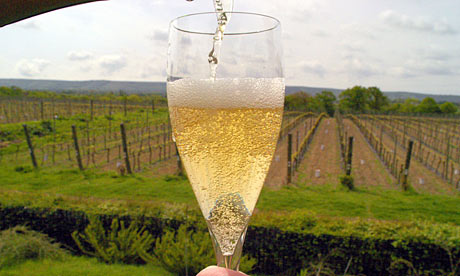
The first English sparkling
wine made by a French champagne maker is about to go on sale, providing the clearest sign yet that British fizz is coming of age.
Meonhill, made from grapes grown from French rootstocks planted in Hampshire, will be available early in 2012.
Until
now French wine makers have not invested in cultivation of the grape in
Kent, Sussex and Hampshire – places closely resembling the climate and
chalky geology of northern France.
The planned release of the
first 5,000 bottles by Didier Pierson-Whitaker, owner of a grand cru
vineyard in Champagne, comes as established English vintners of
champagne-style sparkling wines report a dramatic growth in sales and
demand.
Waitrose says sales of 18 English sparkling wines have
risen by almost a third compared with last Christmas, and Ridgeview, a
wine maker in the South Downs, reports trebled sales in the last two
years.
Marcus Waring's recently opened London restaurant, Sir
Gilbert Scott, is now selling more glasses of English sparking wine than
Moët et Chandon, the Champagne region's biggest global brand.
"Demand
is outstripping production and we can't keep up," said Mardi Roberts,
sales manager at Ridgeview, in Sussex, which last month won best
sparkling wine in the 2011 International Wine and Spirit Competition.
"Exports have been a real growth area and now represent 20% of our sales
to places like the US, Finland, Japan and Hong Kong."
Cultivation
in the UK of the three grape varieties used to make traditional
champagne-style sparkling wine – Chardonnay, Pinot Noir and Pinot
Meunier – has more than quadrupled since 2005, according to data held by
the Food Standards Agency.
The grape varieties now grow across
550 hectares (1,235 acres), more than half of the space that is devoted
to vineyards. Farmers are catching on and four parcels of arable land at
Barham Court, in Kent, that until now were planted with cereal crops,
are being sold for use as a sparkling wine vineyard.
Meanwhile,
Waitrose this autumn pressed the first grapes from its own newly planted
vineyard in Hampshire to make an own-brand sparkling wine that will be
ready for drinking in 2013 or 2014.
"When I first put English
sparkling wine on my wine lists five years ago, people were scared,"
said Mark Cesareo, head sommelier at the Sir Gilbert Scott, which stocks
three English sparklers. "The people who were most averse were the
English themselves while tourists and even French people wanted to try
it.
"Now I stock three English wines by the glass, Gusbourne,
Ridgeview and Nyetimber. If I sell 10 cases of Moët week, I will do six
of Gusbourne, five of Ridgeview and three of Nyetimber."
Some wine makers, however, admit to difficulties operating in the UK's nascent wine industry.
"Truthfully,
it has been tough," said Imogen Pierson-Whitaker, who is behind the
Meonhill wine. "We don't have the massive support system you have in
France. We planted in 2005 and the vines have been fabulous some years
and there have been poor years. There is a bit of an issue with the
wind, but that can help prevent mould. It will obviously evolve, but the
beginnings are tough, especially when you are using a new vineyard."
Roberts said: "There is possibly a bit of a gold rush going on. There
are a lot of people planting at the moment, but people underestimate the
cost of producing the wine. We have put in a lot of effort in to get
the standard up and we are conscious of the need to keep it there."
Coates
and Seely, which makes sparkling wines in the north Hampshire downs,
emblazons "Britagne" on the gold foil of its bottle necks and has
suggested that other sparkling wine producers do the same to protect
standards.
Christian Seely, former managing director of Axa
Millésimes, which owns Château Pichon-Longueville and Château Suduiraut,
both celebrated Bordeaux houses, wanted the name to stand for a
specific
"methode brittanique" of vinification. Ridgeview has
trade-marked the word "merret" to describe its English sparkling wine.
In 1662 Christopher Merret presented a paper to the Royal Society in
London which outlined the process of making traditional sparkling wines.
This was, Ridgeview says, 30 years before the technique was documented
in Champagne.
Carr Taylor mixed case of English sparkling wine as an example of excellent UK-style Champagne  Hammerpot
Brewery is delighted to announce that their “Bottle Wreck Porter” has been
awarded GOLD in the Porter category at Campaign for Real Ale’s (CAMRA) 2012
National Winter Ales Festival in Manchester.
Hammerpot
Brewery is delighted to announce that their “Bottle Wreck Porter” has been
awarded GOLD in the Porter category at Campaign for Real Ale’s (CAMRA) 2012
National Winter Ales Festival in Manchester.